Showing posts with label Mind Hacks. Show all posts

Friday, 20 March 2020

Do we suffer ‘behavioural fatigue’ for pandemic prevention measures?

The Guardian recently published an article saying “People won’t get ‘tired’ of social distancing – and it’s unscientific to suggest otherwise”. “Behavioural fatigue” the piece said, “has no basis in science”.

‘Behavioural fatigue’ became a hot topic because it was part of the UK Government’s justification for delaying the introduction of stricter public health measures. They quickly reversed this position and we’re now in the “empty streets” stage of infection control.

But it’s an important topic and is relevant to all of us as we try to maintain important behavioural changes that benefit others.

For me, one key point is that, actually, there are many relevant scientific studies that tackle this. And I have to say, I’m a little disappointed that there were some public pronouncements that ‘there is no evidence’ in the mainstream media without anyone making the effort to seek it out.

The reaction to epidemics has actually been quite well studied although it’s not clear that ‘fatigue’ is the right way of understanding any potential decline in people’s compliance. This phrase doesn’t seem to be used in the medical literature in this context and it may well have been simply a convenient, albeit confusing, metaphor for ‘decline’ used in interviews.

In fact, most studies of changes in compliance focus on the effect of changing risk perception, and it turns out that this often poorly tracks the actual risk. Below is a graph from a recent paper illustrating a widely used model of how risk perception tracks epidemics.
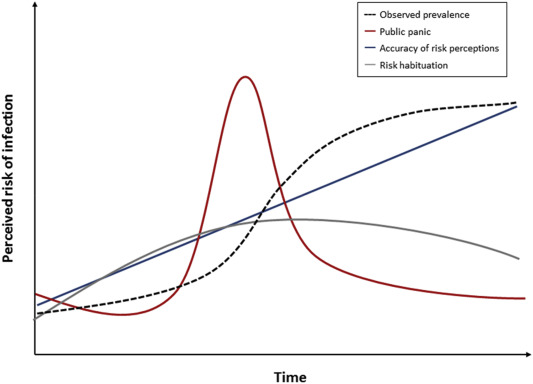
Notably, this model was first published in the 1990s based on data available even then. It suggests that increases in risk tend to make us over-estimate the danger, particularly for surprising events, but then as the risk objectively increases we start to get used to living in the ‘new normal’ and our perception of risk decreases, sometimes unhelpfully so.

What this doesn’t tell us is whether people’s behaviour changes over time. However, lots of studies have been done since then, including on the 2009 H1N1 flu pandemic – where a lot of this research was conducted.

To cut a long story short, many, but not all, of these studies find that people tend to reduce their use of at least some preventative measures (like hand washing, social distancing) as the epidemic increases, and this has been looked at in various ways.

When asking people to report their own behaviours, several studies found evidence for a reduction in at least some preventative measures (usually alongside evidence for good compliance with others).

This was found was found in one study in Italy, two studies in Hong Kong, and one study in Malaysia.

In Holland during the 2006 bird flu outbreak, one study did seven follow-ups and found a fluctuating pattern of compliance with prevention measures. People ramped up their prevention efforts, then their was a dip, then they increased again.

Some studies have looked for objective evidence of behaviour change and one of the most interesting looked at changes in social distancing during the 2009 outbreak in Mexico by measuring television viewing as a proxy for time spent in the home. This study found that, consistent with an increase in social distancing at the beginning of the outbreak, television viewing greatly increased, but as time went on, and the outbreak grew, television viewing dropped. To try and double-check their conclusions, they showed that television viewing predicted infection rates.

One study looked at airline passengers’ missed flights during the 2009 outbreak – given that flying with a bunch of people in an enclosed space is likely to spread flu. There was a massive spike of missed flights at the beginning of the pandemic but this quickly dropped off as the infection rate climbed, although later, missed flights did begin to track infection rates more closely.

There are also some relevant qualitative studies. These are where people are free-form interviewed and the themes of what they say are reported. These studies reported that people resist some behavioural measures during outbreaks as they increasingly start to conflict with family demands, economic pressures, and so on.

Rather than measuring people’s compliance with health behaviours, several studies looked at how epidemics change and used mathematical models to test out ideas about what could account for their course.

One well recognised finding is that epidemics often come in waves. A surge, a quieter period, a surge, a quieter period, and so on.

Several mathematical modelling studies have suggested that people’s declining compliance with preventative measures could account for this. This has been found with simulated epidemics but also when looking at real data, such as that from the 1918 flu pandemic. The 1918 epidemic was an interesting example because there was no vaccine and so behavioural changes were pretty much the only preventative measure.

And some studies showed no evidence of ‘behavioural fatigue’ at all.

One study in the Netherlands showed a stable increase in people taking preventative measures with no evidence of decline at any point.

Another study conducted in Beijing found that people tended to maintain compliance with low effort measures (ventilating rooms, catching coughs and sneezes, washing hands) and tended to increase the level of high effort measures (stockpiling, buying face masks).

This improved compliance was also seen in a study that looked at an outbreak of the mosquito-borne disease chikungunya.

This is not meant to be a complete review of these studies (do add any others below) but I’m presenting them here to show that actually, there is lots of relevant evidence about ‘behavioural fatigue’ despite the fact that mainstream articles can get published by people declaring it ‘has no basis in science’.

In fact, this topic is almost a sub-field in some disciplines. Epidemiologists have been trying to incorporate behavioural dynamics into their models. Economists have been trying to model the ‘prevalence elasticity’ of preventative behaviours as epidemics progress. Game theorists have been creating models of behaviour change in terms of individuals’ strategic decision-making.

The lessons here are two fold I think.

The first is for scientists to be cautious when taking public positions. This is particularly important in times of crisis. Most scientific fields are complex and can be opaque even to other scientists in closely related fields. Your voice has influence so please consider (and indeed research) what you say.

The second is for all of us. We are currently in the middle of a pandemic and we have been asked to take essential measures.

In past pandemics, people started to drop their life-saving behavioural changes as the risk seemed to become routine, even as the actual danger increased.

This is not inevitable, because in some places, and in some outbreaks, people managed to stick with them.

We can be like the folks who stuck with these strange new rituals, who didn’t let their guard down, and who saved the lives of countless people they never met.


from Mind Hacks https://ift.tt/3detJA1
via https://ifttt.com/ IFTTT

Thursday, 13 September 2018

The Choice Engine

A project I’ve been working on a for a long time has just launched:
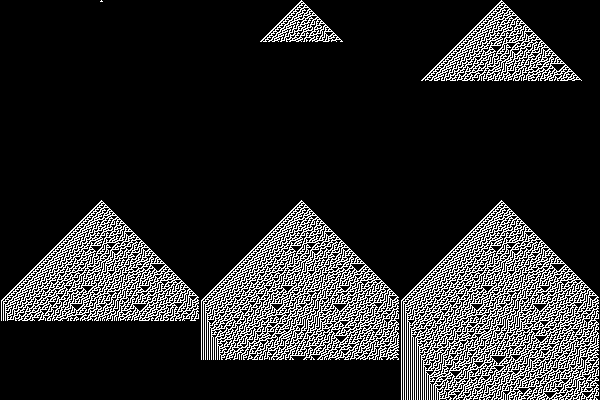
By talking to the @ChoiceEngine twitter-bot you can navigate an essay about choice, complexity and the nature of our minds. Along the way I argue why the most famous experiment on the neuroscience of free will doesn’t really tell us much, and discuss the wasp which made Darwin lose his faith in a benevolent god. And there’s this animated gif:

Tweet START @ChoiceEngine to begin


from Mind Hacks https://ift.tt/2QqOAEM
via https://ifttt.com/ IFTTT

Wednesday, 15 August 2018

After the methods crisis, the theory crisis

This thread started by Ekaterina Damer has prompted many recommendations from psychologists on twitter.

Here are most of the recommendations, with their recommender in brackets. I haven’t read these, but wanted to collate them in one place. Comments are open if you have your own suggestions.

(Iris van Rooij)

“How does it work?” vs. “What are the laws?” Two conceptions of psychological explanation. Robert Cummins

(Ed Orehek)
Theory Construction in Social Personality Psychology: Personal Experiences and Lessons Learned: A Special Issue of Personality and Social Psychology Review

(Djouria Ghilani)
Personal Reflections on Theory and Psychology
Gerd Gigerenzer,

Selected Works of Barry N. Markovsky

(pretty much everyone, but Tal Yarkoni put it like this)
“Meehl said most of what there is to say about this”

(Which reminds me, PsychBrief has been reading Meehl and provides extensive summaries here: Paul Meehl on philosophy of science: video lectures and papers)

(Burak Tunca)
What Theory is Not by Robert I. Sutton & Barry M. Staw

(Joshua Skewes)
Valerie Gray Hardcastle’s “How to build a theory in cognitive science”.

(Randy McCarthy)
Chapter 1 of Gawronski, B., & Bodenhausen, G. V. (2015). Theory and explanation in social psychology. Guilford Publications.

(Kimberly Quinn)
McGuire, W. J. (1997). Creative hypothesis generating in psychology: Some useful heuristics. Annual review of psychology, 48(1), 1-30.

(Daniƫl Lakens)
Jaccard, J., & Jacoby, J. (2010). Theory Construction and Model-building Skills: A Practical Guide for Social Scientists. Guilford Press.

Fiedler, K. (2004). Tools, toys, truisms, and theories: Some thoughts on the creative cycle of theory formation. Personality and Social Psychology Review, 8(2), 123–131.

(Tom Stafford)
Roberts and Pashler (2000). How persuasive is a good fit? A comment on theory testing

From the discussion it is clear that the theory crisis will be every bit as rich and full of dissent as the methods crisis.


from Mind Hacks https://ift.tt/2nDP79m
via https://ifttt.com/ IFTTT

Tuesday, 14 August 2018

Open Science Essentials: Preprints

Open science essentials in 2 minutes, part 4

Before a research article is published in a journal you can make it freely available for anyone to read. You could do this on your own website, but you can also do it on a preprint server, such as psyarxiv.com, where other researchers also share their preprints, which is supported by the OSF so will be around for a while, and which allows you to find others’ research easily.

Preprint servers have been used for decades in physics, but are now becoming more common across academia. Preprints allow rapid dissemination of your research, which is especially important for early career researchers. Preprints can be cited and indexing services like Google Scholar will join your preprint citations with the record of your eventual journal publication.

Preprints also mean that work can be reviewed (and errors-caught) before final publication.

What happens when my paper is published?

Your work is still available in preprint form, which means that there is a non-paywalled version and so more people will read and cite it. If you upload a version of the manuscript after it has been accepted for publication that is called a post-print.

What about copyright?

Mostly journals own the formatted, typeset version of your published manuscript. This is why you often aren’t allowed to upload the PDF of this to your own website or a preprint server, but there’s nothing stopping you uploading a version with the same text (so the formatting will be different, but the information is the same).

Will journals refuse my paper if it is already “published” via a preprint?

Most journals allow, or even encourage preprints. A diminishing minority don’t. If you’re interested you can search for specific journal policies here.

Will I get scooped?

Preprints allow you to timestamp your work before publication, so they can act to establish priority on a findings which is protection against being scooped. Of course, if you have a project where you don’t want to let anyone know you are working in that area until you’re published, preprints may not be suitable.

When should I upload a preprint?

Upload a preprint at the point of submission to a journal, and for each further submission and upon acceptance (making it a postprint).

What’s to stop people uploading rubbish to a preprint server?

There’s nothing to stop this, but since your reputation for doing quality work is one of the most important things a scholar has I don’t recommend it.

Useful links:

Part of a series:

  1. Pre-registration
  2. The Open Science Framework
  3. Reproducibility


from Mind Hacks https://ift.tt/2nBbOLt
via https://ifttt.com/ IFTTT

Sunday, 17 June 2018

Believing everyone else is wrong is a danger sign

I have a guest post for the Research Digest, snappily titled ‘People who think their opinions are superior to others are most prone to overestimating their relevant knowledge and ignoring chances to learn more‘. The paper I review is about the so-called “belief superiority” effect, which is defined by thinking that your views are better than other people’s (i.e. not just that you are right, but that other people are wrong). The finding that people who have belief superiority are more likely to overestimate their knowledge is a twist on the famous Dunning-Kruger phenomenon, but showing that it isn’t just ignorance that predicts overconfidence, but also the specific belief that everyone else has mistaken beliefs.

Here’s the first lines of the Research Digest piece:

We all know someone who is convinced their opinion is better than everyone else’s on a topic – perhaps, even, that it is the only correct opinion to have. Maybe, on some topics, you are that person. No psychologist would be surprised that people who are convinced their beliefs are superior think they are better informed than others, but this fact leads to a follow on question: are people actually better informed on the topics for which they are convinced their opinion is superior? This is what Michael Hall and Kaitlin Raimi set out to check in a series of experiments in the Journal of Experimental Social Psychology.

Read more here: ‘People who think their opinions are superior to others are most prone to overestimating their relevant knowledge and ignoring chances to learn more


from Mind Hacks https://ift.tt/2tdTUAQ
via https://ifttt.com/ IFTTT

Wednesday, 4 April 2018

Review: John Bargh’s “Before You Know It”

I have a review of John Bargh’s new book “Before You Know It: The Unconscious Reasons We Do What We Do” in this month’s Psychologist magazine. You can read the review in print (or online here) but the magazine could only fit in 250 words, and I originally wrote closer to 700. I’ll put the full, unedited, review below at the end of this post.

John Bargh is one of the world’s most celebrated social psychologists, and has made his name with creative experiments supposedly demonstrating the nature of our unconscious minds. His work, and style of work, has been has been directly or implicitly criticised during the so-called replication crisis in psychology (example), so I approached a book length treatment of his ideas with interest, and in anticipation of how he’d respond to his critics.

Full disclosure: I’ve previously argued that Bargh’s definition of ‘unconscious’ is theoretically incoherent, rather than merely empirically unreliable, so my prior expectations for his book are probably best classified as ‘skeptical’. I did get a free copy though, which always puts me in a good mood.

If you like short and sweet, please pay The Psychologist a visit for the short review. If you’ve patience for more of me (and John Bargh), read on….

Review of

Before you know it: The unconscious reasons we do what do do

by John Bargh

Heinemann, 2017

First the good news. John Bargh is a luminary of social psychology, a charming and expert guide to research on our the importance of our motivations, goals, habits, history and environment in affecting our everyday behaviours. His enthusiasm for the topic, and track record for conducting experiments with just that bit more flair than most psychology studies, shine through this book, as does some his love of his family, of road trips and of Led Zeppelin.  In “Before you know it”, Bargh walks us through a series of striking demonstrations of how small differences can have big effects on our behaviour, perhaps without our full awareness of their import. These are things such as his famous experiment reporting that students who were asked to do a word unscrambling task containing primes of the concept “elderly” walked slower down the corridor upon leaving the experiment, or the study showing that holding a hot drink influenced people to rate a stranger more warmly. In addition to this tour of social psychology experiments by someone with an unrivaled insider’s knowledge, Bargh presents an account of human behaviour which situates our social lives within what we know about cognition, neuroscience and evolution. Social psychology, in his view, is no isolated discipline, but a part of a broader, multidisciplinary, account of the mind. He draws on Skinner, Freud and Darwin as well as a range of important historical and contemporary psychologists.

So, the bad news. Like all of psychology, much of the literature cited in this book has faced new scrutiny as part of the ‘replication crisis’. A core topic of the book, so called ‘social priming’ has been very staunchly criticised for being based on shifting sands of unreliable, selectively published research. This is not the place to critique the reliability of Bargh‘s research methods, but it is remiss that he doesn’t once offer a rejoinder these criticisms.

Bargh‘s over-inclusive use of the term ‘unconscious’ renders the term meaningless, in my opinion. He applies it to any behaviour of which we do not offer full report of all causes. Difficulties with eliciting reliable self-reports on internal states, twinned with the privileged perspective of experimenters (who know the experiment’s conditions) over participants (who each only know one condition) mean it is simply invalid to infer from a lack of report that a participant is unconscious of a driver of their behaviour in any strong way. Bargh can use the word ‘unconscious’ to mean ‘not often discussed’ if he wants, but it is an unfair trick on the reader, who might assume that the word carried some deeper conceptual importance.

Bargh‘s book doesn’t live up to the promise of any of the components. The real world examples of people whose behaviour has been ‘unconsciously’ influenced that he recruits to motivate his chapters are engagingly told, but the analysis is not deep and could have been more thoroughly woven with the experimental results. The experiments described are fascinating, but – and maybe this is the academic in me – I would have loved to have heard more discussion of possible interpretations and more detail on the exact results. The theoretical account of the mind he is advancing is pleasing syncretic, as I mention above, but the experiments are presented as merely confirming some theoretical idea, it is often unclear what theories they disprove or practical applications they endorse. Finally, while the author’s personal character and story feature frequently in the book, it is in a frustrating lack of depth (in one chapter Bargh describes in a few lines how a chance meeting in a diner led to his future marriage, but we learn almost nothing about his wife-to-be. Please, John, if you’re going to gossip, gossip good!). As such a successful psychologist and pivotal researcher, details of how Bargh lives and works could be interesting in and of themselves, but these details are tantalisingly few – Bargh‘s charms come through, but as with the research, there aren’t enough details to really satisfy.


from Mind Hacks https://ift.tt/2GyPz0w
via https://ifttt.com/ IFTTT

Monday, 26 February 2018

spaced repetition & Darwin’s golden rule

Spaced repetition is a memory hack. We know that spacing out your study is more effective than cramming, but using an app you can tailor your own spaced repetition schedule, allowing you to efficiently create reliable memories for any material you like.

Michael Nielsen, has a nice thread on his use of spaced repetition on twitter:

He covers how he chooses what to put into his review system, what the right amount of information is for each item, and what memory alone won’t give you (understanding of the process which uses the memorised items). Nielsen is pretty enthusiastic about the benefits:

The single biggest change is that memory is no longer a haphazard event, to be left to chance. Rather, I can guarantee I will remember something, with minimal effort: it makes memory a  choice.

There are lots of apps/programmes which can help you run a spaced repetition system, but Nielsen used Anki (ankiweb.net), which is open source, and has desktop and mobile clients (which sync between themselves, which is useful if you want to add information while at a computer, then review it on your mobile while you wait in line for coffee or whatever).

Checking Anki out, it seems pretty nice, and I’ve realised I can use it to overcome a cognitive bias we all suffer from: a tendency to forget facts which are an inconvenient for our beliefs.

Charles Darwin notes this in his autobiography:

“I had, also, during many years, followed a golden rule, namely, that whenever a published fact, a new observation or thought came across me, which was opposed to my general results, to make a memorandum of it without fail and at once; for I had found by experience that such facts and thoughts were far more apt to escape from the memory than favourable ones. Owing to this habit, very few objections were raised against my views which I had not at least noticed and attempted to answer.”

(Darwin, 1856/1958, p123).

I have notebooks, and Darwin’s habit of forgetting “unfavourable” facts, but I wonder if my thinking might be improved by not just noting the facts, but being able to keep them in memory – using a spaced repetition system. I’m going to give it a go.

Links & Footnotes:

Anki app (ankiweb.net)

Wikipedia on space repetition systems

The Autobiography of Charles Darwin, 1809–1882, edited by Nora Barlow. London: Collins

For more on the science, see this recent review for educators: Weinstein, Y., Madan, C. R., & Sumeracki, M. A. (2018). Teaching the science of learning. Cognitive research: principles and implications, 3(1), 2.

I note that Anki-based spaced repetition also does a side serving of retrieval practice and interleaving (other effective learning techniques).


from Mind Hacks http://ift.tt/2orwvKm
via https://ifttt.com/ IFTTT

Wednesday, 7 February 2018

How To Become A Centaur

Nicky Case (of Explorable Explanations and Parable of the Polygons internet fame) has a fantastic essay which picks up on the theme of my last Cyberselves post – technology as companion, not competitor.

In How To Become A Centaur Case gives blitz history of AI, and of its lesser known cousin IA – Intelligence Augmentation. The insight that digital technology could be a a ‘bicycle for the mind’ (Steve Jobs’ quote) gave us the modern computer, as shown in the 1968 Mother of All Demos which introduced the world to the mouse, hypertext, video conferencing and collaborative working. (1968 people! 1968! As Case notes, 44 years before google docs, 35 years before skype).

We’re living in the world made possible by Englebart’s demo. Digital tools, from mere phones to the remote presence they enable, or the remote action that robots are surely going to make more common, and as Case says:

a tool doesn’t “just” make something easier — it allows for new, previously-impossible ways of thinking, of living, of being.

And the vital insight is that the future will rely on identifying the strengths and weakness of natural and artificial cognition, and figuring out how to harness them together. Case again:

When you create a Human+AI team, the hard part isn’t the “AI”. It isn’t even the “Human”.

It’s the “+”.

The article is too good to try to summarise. Read the full text here

Cross-posted at the Cyberselves blog.

Previously: Tools, substitutes or companions: three metaphors for thinking about technology, Cyberselves: How Immersive Technologies Will Impact Our Future Selves


from Mind Hacks http://ift.tt/2nRnMQR
via https://ifttt.com/ IFTTT

Friday, 26 January 2018

Debating Sex Differences: Talk transcript

A talk I gave titled “Debating Sex Differences in Cognition: We Can Do Better” now has a home on the web.
The pages align a rough transcript of the talk with the slides, for your browsing pleasure.

Mindhacks.com readers will recognise many of the slides, which started their lives as blog posts. The full series is linked from this first post: Gender brain blogging. The whole thing came about because I was teaching a graduate discussion class on Cordelia Fine’s book, and then Andrew over at psychsciencenotes invited me to give a talk about it.

Here’s a bit from the introduction:

I love Fine’s book. I think of it as a sort of Bad Science but for sex differences research. Part of my argument in this talk is that Fine’s book, and reactions to it, can show us something important about how psychology is conducted and interpreted. The book has flaws, and some people hate it, and those things too are part of the story about the state of psychological research.

More here


from Mind Hacks http://ift.tt/2Bwqsb8
via https://ifttt.com/ IFTTT

Wednesday, 3 January 2018

The backfire effect is elusive

The backfire effect is when correcting misinformation hardens, rather than corrects, someone’s mistaken belief. It’s a relative of so called ‘attitude polarisation’ whereby people’s views on politically controversial topics can get more, not less, extreme when they are exposed to counter-arguments.

The finding that misperception are hard to correct is not new – it fits with research on the tenacity of beliefs and the difficulty of debunking.

The backfire effect appears to give an extra spin on this. If backfire effects hold, then correcting fake news can be worse than useless – the correction could reinforce the misinformation in people’s minds. This is what Brendan Nyhan and Jason Reifler warned about in a 2010 paper ‘When Corrections Fail: The Persistence of Political Misperceptions’.

Now, work by Tom Wood and Ethan Porter suggests that backfire effects may not be common or reliable. Reporting in their ‘The Elusive Backfire Effect: Mass Attitudes’ Steadfast Factual Adherence’ they exposed over 10,000 mechanical turk participants, over 5 experiments and 52 different topics, to misleading statements from American politicians from both of the two main parties. Across all statements, and all experiments, they found that showing people corrections moved their beliefs away from the false information. There was an effect of the match between the ideology of the participant and of the politician, but it wasn’t large:

Among liberals, 85% of issues saw a significant factual response to correction, among moderates, 96% of issues, and among conservatives, 83% of issues. No backfire was observed for any issue, among any ideological cohort

All in all, this suggests, in their words, that ‘The backfire effect is far less prevalent than existing research would indicate’. Far from being counter-productive, corrections work. Part of the power of this new study is that it uses the same materials and participants as the 2010 paper reporting backfire effects – statements about US politics and US citizens. Although the numbers mean the new study in convincing, it doesn’t show the backfire effect will never occur, especially for different attitudes in different contexts or nations.

So, don’t give up on fact checking just yet – people are more more reasonable about their beliefs than the backfire suggests.

Original paper: Nyhan, B., & Reifler, J. (2010). When corrections fail: The persistence of political misperceptions. Political Behavior, 32(2), 303-330.

New studies: Wood, T., & Porter, E. (in press). The elusive backfire effect: Mass attitudes’ steadfast factual adherence. Political Behaviour.

The news is also good in a related experiment on fake news by the same team: Sex Trafficking, Russian Infiltration, Birth Certificates, and Pedophilia: A Survey Experiment Correcting Fake News. Regardless of ideology or content of fake news, people were responsive to corrections.

Read more about the psychology of responsiveness to argument in my ‘For argument’s sake: evidence that reason can change minds’.


from Mind Hacks http://ift.tt/2lLxG5j
via https://ifttt.com/ IFTTT

Tuesday, 2 January 2018

Open Science Essentials: Reproducibility

Open science essentials in 2 minutes, part 3

Let’s define it this way: reproducibility is when your experiment or data analysis can be reliably repeated. It isn’t replicability, which we can define as reproducing an experiment and subsequent analysis and getting qualitatively similar results with the new data. (These aren’t universally accepted definitions, but they are common, and enough to get us started).

Reproducibility is a bedrock of science – we all know that our methods section should contain enough detail to allow an independent researcher to repeat our experiment. With the increasing use of computational methods in psychology, there’s increasing need – and increasing ability – for us to share more than just a description of our experiment or analysis.

Reproducible methods

Using sites like the Open Science Framework you can share stimuli and other materials. If you use open source experiment software like PsychoPy or Tatool you can easily share the full scripts which run your experiment and people on different platforms and without your software licenses can still run your experiment.

Reproducible analysis

Equally important is making your analysis reproducible. You’d think that with the same data, another person – or even you in the future – would get the same results. Not so! Most analyses include thousands of small choices. A mis-step in any of these small choices – lost participants, copy/paste errors, mis-labeled cases, unclear exclusion criteria – can derail an analysis, meaning you get different results each time (and different results from what you’ve published).

Fortunately a solution is at hand! You need to use analysis software that allows you to write a script to convert your raw data into your final output. That means no more Excel sheets (no history of what you’ve done = very bad – don’t be these guys) and no more point-and-click SPSS analysis.

Bottom line: You must script your analysis – trust me on this one

Open data + code

You need to share and document your data and your analysis code. All this is harder work than just writing down the final result of an analysis once you’ve managed to obtain it, but it makes for more robust analysis, and allows someone else to reproduce your analysis easily in the future.

The most likely beneficiary is you – you most likely collaborator in the future is Past You, and Past You doesn’t answer email. Every analysis I’ve ever done I’ve had to repeat, sometimes years later. It saves time in the long run to invest in making a reproducible analysis first time around.

Further Reading

Nick Barnes: Publish your computer code: it is good enough

British Ecological Society: Guide to Reproducible Code

Gael Varoquaux : Computational practices for reproducible science

Advanced

Reproducible Computational Workflows with Continuous Analysis

Best Practices for Computational Science: Software Infrastructure and Environments for Reproducible and Extensible Research

Part of a series for graduate students in psychology.
Part 1: pre-registration.
Part 2: the Open-Science Framework.

Part 3: Reproducibility


from Mind Hacks http://ift.tt/2CHhH0f
via https://ifttt.com/ IFTTT

Monday, 25 December 2017

The Human Advantage

In ‘The Human Advantage: How Our Brains Became Remarkable’, Suzana Herculano-Houzel weaves together two stories: the story of her scientific career, based on her invention of a new technique for counting the number of brain cells in an entire brain, and the story of human brain evolution.

Previously counts of neurons in brains of humans and other animals relied on sampling: counting the cells in a slice of tissue and multiplying up to get an estimate. Because of differences in cell types and numbers across brain regions, these estimates are uncertain. Herculano-Houzel’s technique involves liquidizing a whole brain or brain region so that a sample of this homogeneous mass can yield reliable estimates of total cell count. Herculano-Houzel calls it “brain soup”.

The Human Advantage is the story of her discovery and the collaborations that led her to apply the technique to rodent, primate and human brains, and eventually to everything from giraffes to elephants.

Along the way she made various discoveries that contradict received wisdom in neuroscience:
most species (including rodents primates) have 80% of the neurons in the cerebellum
humans have about 86 billion neurons (16.3 billion in cerebral cortex), which is a missing 14 billion neurons compared to the conventional estimate.
– you can’t compare brain size to count brain cells. Because the cell volume changes with body size, some species with bigger brains have fewer neurons, and species with the same size brains can have vastly different neuron counts.

Example 1
* The capybara (a rodent), cerebral cortex has a weight of 48.2g and 306 million neurons
* The bonnet monkey (a primate), cerebral cortex has a weight of 48.3g and 1.7 billion neurons

Example 2
* African elephant, body mass 5000 kg, brain mass 4619g, 5.6 billion cerebral cortex neurons
* Human, body mass 70 kg, brain mass 1509g, 16.3 cerebral cortex neurons

(Fun fact:elephant neurons are 98% in the cerebellum – possibly because of the evolution of the trunk).

A lot of the book is concerned with relative as well as absolute numbers of brain cells. A frequent assumption is that humans must have more cortex relative to the rest of their brain, or more prefrontal cortex relative to the rest of the cortex. This is not true, says Herculano-Houzel’s research. The exception in nature is primates, who show a greater density of neurons per gram of brain mass and more energetically efficient neurons in terms of metabolic requirement per neuron. Humans are no exception to the scaling laws that govern primates, but we are particularly large (a caveat is great apes, who have larger bodies than us, but smaller brains, departing from the body-brain scaling law that govern humans and other primates). Our cognitive exceptionalism is based on raw number of brain cells in the cortex – that’s the human advantage.

This is a book which blends a deep look into comparative neuroanatomy and the evolutionary story of the brain with the specific research programme of one scientist. It shows how much progress in science depends on technological innovation, hard work, a bit of luck, social connections and thoughtful integration of the ideas of others. A great book – mindhacks.com recommends!


from Mind Hacks http://ift.tt/2l8dY3z
via https://ifttt.com/ IFTTT

Saturday, 23 December 2017

Conspiracy theories as maladaptive coping

A review called ‘The Psychology of Conspiracy Theories‘ sets out a theory of why individuals end up believing Elvis is alive, NASA faked the moon landings or 9/11 was an inside job. Karen Douglas and colleagues suggest:

Belief in conspiracy theories appears to be driven by motives that can be characterized as epistemic (understanding one’s environment), existential (being safe and in control of one’s environment), and social (maintaining a positive image of the self and the social group).

In their review they cover evidence showing that factors like uncertainty about the world, lack of control or social exclusion (factors affecting epistemic, existential and social motives respectively) are all associated with increased susceptibility to conspiracy theory beliefs.

But also they show, paradoxically, that exposure to conspiracy theories doesn’t salve these needs. People presented with pro-conspiracy theory information about vaccines or climate change felt a reduced sense of control and increased disillusion with politics and distrust of government. Douglas’ argument is that although individuals might find conspiracy theories attractive because they promise to make sense of the world, they actually increase uncertainty and decrease the chance people will take effective collective action.

My take would be that, viewed like this, conspiracy theories are a form of maladaptive coping. The account makes sense of why we are all vulnerable to conspiracy theories – and we are all vulnerable; many individual conspiracy theories have very widespread subscription – for example half of Americans believe Lee Harvey Oswald did not act alone in the assassination of JFK. Of course polling about individual beliefs must underestimate the proportion of individuals who subscribe to at least one conspiracy theory. The account also makes sense of why some people are more susceptible than others – people who have less education, are more excluded or powerless and have a heightened need to see patterns which aren’t necessarily there.

There are a few areas where this account isn’t fully satisfying.
– it doesn’t really offer a psychologically grounded definition of conspiracy theories. Douglas’s working definition is ‘explanations for important events that involve secret plots by powerful and malevolent groups’, which seems to include some cases of conspiracy beliefs which aren’t ‘conspiracy theories’ (sometimes it is reasonable to believe in secret plots by the powerful; sometimes the powerful are involved in secret plots), and it seems to miss some cases of conspiracy-theory type reasoning (for example paranoid beliefs about other people in your immediate social world).
– one aspects of conspiracy theories is that they are hard to disprove, with, for example, people presenting contrary evidence seem as confirming the existence of the conspiracy. But the common psychological tendency to resist persuasion is well known. Are conspiracy theories especially hard to shift, any more than other beliefs (or the beliefs of non-conspiracy theorists)? Would it be easier to persuade you that the earth is flat than it would be to persuade a flat-earther that the earth is round? If not, then the identifying mark of conspiracy theories may be the factors that lead you to get into them, rather that their dynamics when you’ve got them.
– and how you get into them seems crucially unaddressed by the experimental psychology methods Douglas and colleagues deploy. We have correlational data on the kinds of people who subscribe to conspiracy theories, and experimental data on presenting people with conspiracy theories, but no rich ethnographic account of how individuals find themselves pulled into the world of a conspiracy theory (or how they eventually get out of it).

Further research is, as they say, needed.

Reference: Douglas, K., Sutton, R. M., & Cichocka, A. (2017). The psychology of conspiracy theories. Current Directions in Psychological Science, 26 (6), 538-542.

Karen Douglas’ homepage

Previously on mindhacks.com: Conspiracy theory as character flaw, That’s what they want you to believe. Conspiracy theory page on mindhacks wiki.

I saw Karen Douglas present this work at a talk to Sheffield Skeptics in the Pub. Thanks to them for organising.


from Mind Hacks http://ift.tt/2BU9IMZ
via https://ifttt.com/ IFTTT

Thursday, 14 December 2017

Cyberselves: How Immersive Technologies Will Impact Our Future Selves

We’re happy to announce the re-launch of our project ‘Cyberselves: How Immersive Technologies Will Impact Our Future Selves’. Straight out of Sheffield Robotics, the project aims to explore the effects of technology like robot avatars, virtual reality, AI servants and other tech which alters your perception or ability to act. We’re interested in work, play and how our sense of ourselves and our bodies is going to change as this technology becomes more and more widespread.

We’re funded by the AHRC to run workshops and bring our roadshow of hands on cyber-experiences to places across the UK in the coming year. From the website:

Cyberselves will examine the transforming impact of immersive technologies on our societies and cultures. Our project will bring an immersive, entertaining experience to people in unconventional locations, a Cyberselves Roadshow, that will give participants the chance to transport themselves into the body of a humanoid robot, and to experience the world from that mechanical body. Visitors to the Roadshow will also get a chance to have hands-on experiences with other social robots, coding and virtual/augmented reality demonstrations, while chatting to Sheffield Robotics’ knowledgeable researchers.

The project is a follow-up to our earlier AHRC project, ‘Cyberselves in Immersive Technologies‘, which brought together robotics engineers, philosophers, psychologists, scholars of literature, and neuroscientists.

We’re running a workshop on the effects of teleoperation and telepresence, in Oxford in February (Link).

Call for papers: symposium on AI, robots and public engagement at 2018 AISB Convention (April 2018).

Project updates on twitter, via Dreaming Robots (‘Looking at robots in the news, films, literature and the popular imagination’).

Full disclosure: This is a work gig, so I’m effectively being paid to write this


from Mind Hacks http://ift.tt/2nYTT48
via https://ifttt.com/ IFTTT

Thursday, 9 November 2017

Open Science Essentials: The Open Science Framework

Open science essentials in 2 minutes, part 2

The Open Science Framework (osf.io) is a website designed for the complete life-cycle of your research project – designing projects; collaborating; collecting, storing and sharing data; sharing analysis scripts, stimuli, results and publishing results.

You can read more about the rationale for the site here.

Open Science is fast becoming the new standard for science. As I see it, there are two major drivers of this:

1. Distributing your results via a slim journal article dates from the 17th century. Constraints on the timing, speed and volume of scholarly communication no longer apply. In short, now there is no reason not to share your full materials, data, and analysis scripts.

2. The Replicability crisis means that how people interpret research is changing. Obviously sharing your work doesn’t automatically make it reliable, but since it is a costly signal, it is a good sign that you take the reliability of your work seriously.

You could share aspects of your work in many ways, but the OSF has many benefits

  • the OSF is backed by serious money & institutional support, so the online side of your project will be live many years after you publish the link
  • It integrates with various other platform (github, dropbox, the PsyArXiv preprint server)
  • Totally free, run for scientists by scientists as a non-profit

All this, and the OSF also makes easy things like version control and pre-registration.

Good science is open science. And the fringe benefit is that making materials open forces you to properly document everything, which makes you a better collaborator with your number one research partner – your future self.

Cross-posted at tomstafford.staff.shef.ac.uk.  Part of a series aimed at graduate students in psychology. Part 1: pre-registration.


from Mind Hacks http://ift.tt/2AtRm4e
via https://ifttt.com/ IFTTT

Open Science Essentials: pre-registration

Open Science essentials in 2 minutes, part 1

The Problem

As a scholarly community we allowed ourselves to forget the distinction between exploratory vs confirmatory research, presenting exploratory results as confirmatory, presenting post-hoc rationales as predictions. As well as being dishonest, this makes for unreliable science.

Flexibility in how you analyse your data (“researcher degrees of freedom“) can invalidate statistical inferences.

Importantly, you can employ questionable research practices like this (“p-hacking“) without knowing you are doing it. Decide to stop an analysis because the results are significant? Measure 3 dependent variables and use the one that “works”? Exclude participants who don’t respond to your manipulation? All justified in exploratory research, but mean you are exploring a garden of forking paths in the space of possible analysis – when you arrive at a significant result, you won’t be sure you got there because of the data, or your choices.

The solution

There is a solution – pre-registration. Declare in advance the details of your method and your analysis: sample size, exclusion conditions, dependent variables, directional predictions.

You can do this

Pre-registration is easy. There is no single, universally accepted, way to do it.

  • you could write your data collection and analysis plan down and post it on your blog.
  • you can use the Open Science Framework to timestamp and archive a pre-registration, so you can prove you made a prediction ahead of time.
  • you can visit AsPredicted.org which provides a form to complete, which will help you structure your pre-registration (making sure you include all relevant information).
  • Registered Reports“: more and more journals are committing to published pre-registered studies. They review the method and analysis plan before data collection and agree to publish once the results are in (however they turn out).

You should do this

Why do this?

  • credibility – other researchers (and journals) will know you predicted the results before you got them.
  • you can still do exploratory analysis, it just makes it clear which is which.
  • forces you to think about the analysis before collecting the data (a great benefit).
  • more confidence in your results.

Further reading

Cross-posted on at tomstafford.staff.shef.ac.uk.  Part of a series aimed at graduate students in psychology. Part 2: The Open Science Framework


from Mind Hacks http://ift.tt/2yIW6pj
via https://ifttt.com/ IFTTT

Saturday, 12 August 2017

Should we stop saying ‘commit’ suicide?

There is a movement in mental health to avoid the phrase ‘commit suicide’. It is claimed that the word ‘commit’ refers to a crime and this increases the stigma for what’s often an act of desperation that deserves compassion, rather than condemnation.

The Samaritans’ media guidelines discourage using the phrase, advising: “Avoid labelling a death as someone having ‘committed suicide’. The word ‘commit’ in the context of suicide is factually incorrect because it is no longer illegal”. An article in the Australian Psychological Society’s InPsych magazine recommended against it because the word ‘commit’ signifies not only a crime but a religious sin. There are many more such claims.

However, on the surface level, claims that the word ‘commit’ necessarily indicates a crime are clearly wrong. We can ‘commit money’ or ‘commit errors’, for instance, where no crime is implied. The dictionary entry for ‘commit’ (e.g. see the definition at the OED) has entries related to ‘committing a crime’ as only a few of its many meanings.

But we can probably do a little better when considering the potentially stigmatising effects of language than simply comparing examples.

One approach is to see how the word is actually used by examining a corpus of the English language – a database of written and transcribed spoken language – and using a technique called collocation analysis that looks at which words appear together.

I’ve used the Corpus of Contemporary American English collocation analysis for the results below and you can do the analysis yourself if you want to see what it looks like.

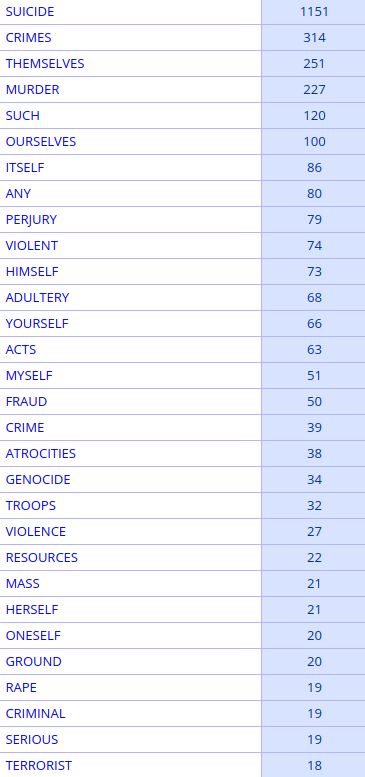
So here are the top 30 words that follow the word ‘commit’, in order of frequency in the corpus.

Some of the words are clearly parts of phrases (‘commit ourselves…’) rather than directly referring to actions but you can see that most common two word phrase is ‘commit suicide’ by a very large margin.

If we take this example, the argument for not using ‘commit suicide’ gets a bit circular but if we look at the other named actions as a whole, they’re all crimes or potential crimes. Essentially, they’re all fairly nasty.

If you do the analysis yourself (and you’ll have to go to the website and type in the details, you can’t link directly) you’ll see that non-criminal actions don’t appear until fairly low down the list, way past the 30 listed here.

So ‘commit’ typically refers to antisocial and criminal acts. Saying ‘commit suicide’ probably brings some of that baggage with it and we’re likely to be better off moving away from it.

It’s worth saying, I’m not a fan of prohibitions on words or phrases, as it tends to silence people who have only colloquial language at their disposal to advocate for themselves.

As this probably includes most people with mental health problems, only a minority of which will be plugged into debates around language, perhaps we are better off thinking about moving language forward rather than punishing the non-conforming.


from Mind Hacks http://ift.tt/2vrZuSf
via https://ifttt.com/ IFTTT